



19 november 2025: zie ook dit artikel: https://kanker-actueel.nl/NL/177lu-psma-617-naast-hormoontherapie-plus-een-hormoonreceptorremmer-arpi-verlengt-aantoonbaar-de-ziekteprogressievrije-overleving-bij-mannen-met-uitgezaaide-hormoongevoelige-prostaatkanker.html
Of u kunt een urinetest laten doen bij oplopende PSA, zie deze informatie:
17 oktober 2022: Zie ook dit artikel : https://kanker-actueel.nl/pembrolizumab-plus-olaparib-geeft-betere-respons-en-ziekteprogressievrije-overleving-bij-patienten-met-eerder-behandelde-uitgezaaide-prostaatkanker-in-vergelijking-met-abirateron-of-enzalutamide-maar-niet-statistisch-significant.html
5 april 2018: Lees ook dit artikel:
15 november 2017: Recent is deze reviewstudie uitgekomen: Adding abiraterone to androgen deprivation therapy in men with metastatic hormone-sensitive prostate cancer: A systematic review and meta-analysis met deze resultaten die bijzonder goed te noemen zijn.
Resultaten:
We identificeerden drie in aanmerking komende studies, waarvan er één nog steeds patienten aanneemt (PEACE-1(NCT01957436)). Resultaten van de twee andere grote gerandomiseerde studies (LATITUDE (NCT01715285) en STAMPEDE (NCT00268476)), samen goed voor 82% van alle mannen die gerandomiseerd onderzocht waren naar AAP plus ADT versus ADT (zonder docetaxel in beide groepen). De resultaten gaven een statistisch grote significante vermindering van 38% van het risico op overlijden met AAP plus ADT (HR = 0,62, 95% betrouwbaarheidsinterval = 0,53-0,71, p = 0,55 x 10⁻¹⁰), wat zich vertaalt in een absolute verbetering van 14% in overall overleving (OS) na 3 jaar.
Ondanks verschillen in PFS-definities (ziektevrije tijd) in de studies, hebben we ook een consistente en statistisch zeer significante 55% vermindering van het risico van de klinische / radiologische ziektevrije tijd (PFS) (HR = 0,45, 95% BI = 0,40-0,51, p = 0,66 x 10-36) waargenomen met de toevoeging van AAP, wat zich vertaalt naar een absolute verbetering van 28% na 3 jaar.
Er was geen bewijs van een verschil in de OS-overleving voor prostaatkankerpatiënten met verschillende Gleasonscores, de prestatiestatus of de lymfklieren status, maar de overall overleving kan per patiëntenleeftijdsgroep wel verschillen. Er waren meer graad III-IV acute cardiale, vasculaire en lever toxiciteit met AAP plus ADT, maar geen overmaat aan andere toxiciteiten of overlijden.
4 september 2016: lees ook dit artikel:
10 januari 2016: lees ook dit artikel:
17 mei 2015: Lees ook deze twee artikelen:
en deze:
2 oktober 2014: Bron: ESMO 2014
Twee jaar na de uitkomsten van de COU-AA-301 studie blijken de goede resultaten met Abiraterone Acetate opnieuw te worden bevestigd. Het verschil tussen Abiraterone acetate plus prednison in vergelijking met alleen prednison en een placebo blijkt 19% in het voordeel van abiraterone acetate uit te vallen wat betreft de kans op overlijden aan hormoonresistente prostaatkanker die nog geen chemo hebben gehad. Abiraterone zorgde ook voor een significant langere tijd tot pijnstillers moesten worden gebruikt: (mediaan, 33.4 vs. 23.4 maanden, respectievelijk; HR = 0.72., 95% CI = 0.61–0.85; P = .0001). Uitstekende resultaten dus.
After a median follow-up of more than 4 years (49.2 months), patients in the abiraterone arm achieved a median overall survival of 34.7 months compared with 30.3 months in the placebo arm (hazard ratio = 0.81, 95% confidence interval = 0.70–0.93, P = .0033).
The final analysis is the first to demonstrate a statistically significant improvement in overall survival in this study. "Overall survival is particularly noteworthy in COU-AA-302, because 67% of men in the abiraterine-plus-prednisone arm and 80% in the control arm received subsequent therapy. This includes 44% of men in the control arm who subsequently received abiraterone plus prednisone," said lead investigator Charles Ryan, MD, Professor of Clinical Medicine, Urology at the University of California, San Francisco. "The use of subsequent therapies did not impact the statistical significance between the abiraterone and control arms—and makes these results all the more compelling after adjusting for the crossover effect."
In addition, the final analysis demonstrated a significant improvement in median time to opiate use for cancer-related pain compared to placebo plus prednisone (median, 33.4 vs. 23.4 months, respectively; HR = 0.72., 95% CI = 0.61–0.85; P = .0001). With 2 additional years of follow-up since the last clinical cutoff, the safety profile of abiraterone remained unchanged compared to previous reports.
Zie hieronder eerdere informatie over deze studie. Ik heb het abstract van de laatste studiegegevens onderaan toegevoegd.
5 augustus 2014: Lees ook het artikel over bloedtest die biomarker AR-V7 kan aantonen via in bloed circulerende tumorcellen en van grote waarde blijkt voor prognose of Abiraterone en enzalutamide wel of niet zal aanslaan bij patiënten met uitgezaaide hormoonresistente prostaatkanker.
8 juni 2013: Volgens een oncoloog die ik gisteren sprak wordt Abiraterone nu ook in Nederland vergoed conform de richtlijnen zoals die gelden in andere landen voor Abiraterone. Dus onderstaand schrijven van 3 april lijkt opgelost. Maar ik weet natuurlijk niet hoe dit in de praktijk gaat. Meldt ons uw ervaringen aub als u Abiraterone wordt geweigerd of juist wel wordt voorgeschreven. Andere mannen met prostaatkanker kunnen daarvan dan kennis nemen en eventueel naar handelen.
3 april 2013: Navraag leert dat Abiraterone in alle landen van Europa wordt vergoed, ook als de patiënt nog geen chemo heeft gehad als behandeling, alleen in Nederland nog niet. Daar wordt Abiraterone alleen voorgeschreven en vergoed als de patiënt ook al chemo heeft gehad. Volgens de door mij geraadpleegde uroloog / oncoloog komt dit omdat de zorgautoriteit nog geen toestemming voor vergoeding heeft gegeven. Er loopt nog onderzoek daarnaar. Een beslissing daarover wordt dit najaar verwacht. Het is toch een grote schande en overduidelijk een vorm van belangenverstrengeling met de chemo leverende farmacie die dit laat bestaan in Nederland.
5 december 2012: The Lancet heeft het studierapport van onderstaande studie deze week gepubliceerd.
2 mei 2011: Bron FDA
Abiraterone Acytate, een oraal in te nemen medicijn, is nu officieel door de FDA goedgekeurd om als medicijn te gebruiken bij gevorderde hormoon resistente prostaatkanker. Dit naar aanleiding van goede resultaten uit een recente fase III studie. Let wel de resultaten zijn vergeleken met een groep die chemo heeft gehad, niet met een groep patienten die nooit chemo hebben gehad. Wat niet wegneemt dat dit wel een optie meer is voor prostaatkankerpatienten. De resultaten op mediane overlevingstijd zijn vergelijkbaar met dendritische celtherapie met Provenge.
In de COU-AA-301 studie, auteurs Dr. de Bono en collega's, werden 1195 patienten met uitgezaaide en hormoonresistente prostaatkanker die eerder waren behandeld met chemo, docetaxel, gerandomiseerd verdeeld over twee groepen: de eerste groep kreeg abiraterone, 1000 mg, plus prednison, 5 mg, 2x per dag (n = 797) of placebo plus prednison (n = 398) in 147 ziekenhuizen in 13 verschillende landen.
Primaire en Secondairy eindpunten van de studie:
| Response | Abiraterone Acetate Group | Placebo Group | P Value |
| Median overall survival (mo) | 14.8 | 10.9 | < .0001 |
| Time to PSA progression (mo) | 10.2 | 6.6 | < .0001 |
| Radiographic progression-free survival (mo) | 5.6 | 3.6 | < .0001 |
| PSA response (%) | 38 | 10 | < .0001 |
Bijwerkingen werden in de abiterone groep meer waargenomen maar deze waren volgens de onderzoekers acceptabel en minder dan bv. chemo. Fluid retention was more common (30.5% vs 22.3%), as was hypokalemia (17.1% vs 8.4%), but grade 3/4 hypokalemia (3.8% vs 0.8%) and grade 3/4 hypertension (1.3% vs 0.3%) were infrequent.
Liver function test abnormalities were reported in 10.4% of the patients who received the investigational agent compared with 8.1% in the placebo group. Cardiac problems were also more common in the abiraterone group compared with placebo, at 12.5% vs 9.4%.
Het volledige studierapport is in The Lancet gepubliceerd: hier het abstract:
Food and Drug Administration approved abiraterone acetate (Zytiga Tablets, Centocor Ortho Biotech, Inc.) for use in combination with prednisone for the treatment of patients with metastatic castration-resistant prostate cancer (mCRPC) who have received prior chemotherapy containing docetaxel
Abiraterone Acetate
On April 28, 2011, the U.S. Food and Drug Administration approved abiraterone acetate (Zytiga Tablets, Centocor Ortho Biotech, Inc.) for use in combination with prednisone for the treatment of patients with metastatic castration-resistant prostate cancer (mCRPC) who have received prior chemotherapy containing docetaxel.
The approval is based on the results of a randomized, placebo-controlled, multicenter trial in 1195 patients with mCRPC previously treated with docetaxel-containing regimens. Patients were randomly allocated (2:1) to receive either abiraterone acetate orally at a dose of 1000 mg once daily (N=797) or placebo once daily (N=398). Patients in both arms (abiraterone acetate and placebo) received prednisone 5 mg orally twice daily. Treatment continued until disease progression (defined as a 25% increase in PSA over the patient’s baseline/nadir together with protocol-defined radiographic progression and symptomatic or clinical progression), unacceptable toxicity, initiation of new treatment, or withdrawal. Patients with prior ketoconazole treatment for prostate cancer and a history of adrenal gland or pituitary disorders were excluded.
A pre-specified interim overall survival (OS) analysis was performed when 552 events had occurred. This analysis demonstrated a statistically significant improvement in OS in patients receiving abiraterone acetate compared to those on the placebo-containing arm (HR=0.646; 95% CI: 0.543, 0.768; p < 0.0001). The median OS was 14.8 versus 10.9 months in the abiraterone and placebo arm, respectively. An updated OS analysis, conducted after 775 events, demonstrated a median OS of 15.8 versus 11.2 months in the abiraterone acetate and placebo-containing arms, respectively (HR=0.740; 95% CI: 0.638, 0.859).
The most common adverse reactions (> 5%) were joint swelling or discomfort, hypokalemia, edema, muscle discomfort, hot flush, diarrhea, urinary tract infection, cough, hypertension, arrhythmia, urinary frequency, nocturia, dyspepsia and upper respiratory tract infection. The most common adverse drug reactions resulting in drug discontinuation were increased aspartate aminotransferase and/or alanine aminotransferase, urosepsis and cardiac failure (each in < 1% of patients taking abiraterone).
The most common electrolyte imbalances in patients receiving abiraterone were hypokalemia (28%) and hypophosphatemia (24%). Following interruption of daily corticosteroids and/or with concurrent infection or stress, adrenocortical insufficiency (<1%) has been reported in clinical trials in patients receiving abiraterone acetate at the recommended dose in combination with prednisone.
Abiraterone acetate Cmax and exposure were increased up to 17-fold and 10-fold higher, respectively, when a single dose was administered with a meal compared to a fasting state.
The recommended dose and schedule for abiraterone acetate is 1000 mg orally once daily in combination with prednisone 5 mg orally twice daily. Abiraterone acetate should be taken on an empty stomach. No food should be consumed for at least two hours before the dose of abiraterone acetate is taken and for at least one hour after the abiraterone acetate dose.
Full prescribing information, including clinical trial information, safety, dosing, drug-drug interactions and contraindications is available at: http://www.accessdata.fda.gov/drugsatfda_docs/label/2011/202379lbl.pdf1
Healthcare professionals should report all serious adverse events suspected to be associated with the use of any medicine and device to FDA’s MedWatch Reporting System by completing a form online at http://www.fda.gov/medwatch/report.htm2, by faxing (1-800-FDA-0178) or mailing the postage-paid address form provided online, or by telephone (1-800-FDA-1088).
Abiraterone Plus Prednisone Significantly Improves Overall Survival in Chemotherapy-Naive Metastatic Castration-Resistant Prostate Cancer
753O - Final overall survival (OS) analysis of COU-AA-302, a randomized phase 3 study of abiraterone acetate (AA) in metastatic castration-resistant prostate cancer (mCRPC) patients (pts) without prior chemotherapy
Aim
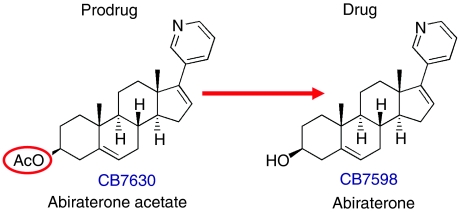
AA is a prodrug of abiraterone, a selective CYP17 inhibitor that blocks androgen biosynthesis and is approved, with prednisone (P), for the treatment of pts with progressive mCRPC. Planned interim analyses of COU-AA-302 (at 13%, 43%, and 56% death events) in mCRPC chemotherapy-naïve pts showed that AA + P significantly delayed disease progression and improved OS compared with P alone, and was well tolerated.1,2 Herein, we report the pre-specified final analysis (96% of planned death events) OS and safety outcomes.
Methods
Pts (N = 1088) were randomized 1:1 to receive AA (1 g) + P (5 mg po BID) vs P. Co-primary end points were radiographic progression-free survival and OS. Median time to events with 95% CI was estimated using the Kaplan-Meier method. Cox model was used to estimate the hazard ratio (HR). Stratified log-rank test was used to test the difference in treatment effect. The O'Brien-Fleming boundary using the Lan-DeMets α-spending function was implemented to control the overall α at 0.04 for OS. For this final analysis, the nominal significance level for efficacy is 0.0384.
Results
With median follow-up of 49.4 mos at final analysis, 741 deaths were observed. 44% of pts in the P arm subsequently received AA + P. AA + P significantly prolonged OS vs P (median OS, 34.7 vs 30.3 mos; HR = 0.80 [95% CI, 0.69-0.93]; p = 0.0027). AEs of special interest were more common with AA + P vs P; grade 3/4 AEs: hypertension, 4.6% vs 3.1%; hypokalemia, 2.6% vs 1.9%; ALT increased, 5.9% vs 0.7%; AST increased, 3.3% vs 0.9%; fluid retention/edema, 1.1% vs 1.7%.
Conclusions
With a median follow-up of more than 4 years, the COU-AA-302 pre-specified, final analysis demonstrates a statistically significant OS benefit with AA + P even though a large number of pts in the P arm received AA + P and other subsequent therapy. With nearly an additional 2 years of follow-up since last reported, AA + P maintains a favorable safety profile and is well tolerated. 1. Ryan CJ et al. NEJM. 2013;368:138-148. 2. Rathkopf DE et al. Eur Urol. 2014 March 6 [Epub ahead of print].
Disclosure
C.J. Ryan: has received honoraria from Janssen; M.R. Smith: has served as a consultant/advisor to and received research funding from Janssen; K. Fizazi: has served as a consultant/advisor to and received honoraria from Janssen; K. Miller: has served as an advisor to Janssen, Medivation, Astellas, Novartis, Merck, Amgen, Bayer, BMS, Dendreon, and Pfizer; C.N. Sternberg: has received honoraria from Astellas, Johnson & Johnson, Ipsen, Bayer, and Millennium; F. Saad: has served as a consultant/advisor to and received honoraria and research funding from Astellas and Janssen;T. Griffin, P. De Porre, Y.C. Park, J. Li and T. Kheoh: is an employee of Janssen and owns stock in Johnson & Johnson;V. Naini: is an employee of Janssen;A. Molina: is an employee of Janssen and owns stock in Johnson & Johnson;D.E. Rathkopf: has served as a consultant/advisor to Johnson & Johnson and has received research funding (uncompensated) from Celgene, Janssen/J&J, Medivation/Astellas, Millennium, and Novartis. All other authors have declared no conflicts of interest.
Plaats een reactie ...
3 Reacties op "Abiraterone Acetate door FDA officieel goedgekeurd om te gebruiken als medicijn bij gevorderde prostaatkanker"
Gerelateerde artikelen
- PARP-remmer niraparib toegevoegd aan abiraterone plus prednison verbetert progressievrije ziektetijd en geeft minder kans op overlijden bij patiënten met uitgezaaide castratieresistente prostaatkanker
- Abiraterone plus hormoontherapie (ADT) geeft bij mannen met hoogrisico niet uitgezaaide prostaatkanker betere uitzaaiingsvrije overleving vergeleken met alleen hormoontherapie
- Abiraterone naast standaardbehandeling verbetert de resultaten bij zowel uitgezaaide als niet uitgezaaide prostaatkanker blijkt uit nieuwe analyses uit 2 grote fase III studies, STAMPEDE en PEACE-1
- Apalutamide en abiraterone acetaat plus prednison vermindert bij patiënten met chemo-naïeve uitgezaaide castratieresistente prostaatkanker met 31 procent het risico op overlijden dan met alleen abiraterone acetate plus prednison
- Abiraterone zonder hormoontherapie geeft dezelfde resultaten op progressievrije ziekte dan abiraterone met hormoontherapie.
- abiraterone acetate (Zytiga) naast standaard behandelingen voor uitgezaaide prostaatkanker vermindert risico op overlijden met 37 procent en kans op recidief met 70 procent.
- abiraterone acetate (Zytiga) geeft 38 procent minder kans op overlijden bij nieuwe diagnose van reeds uitgezaaide prostaatkanker en verdubbelt progressievrije ziekte van 15 naar 33 maanden.
- Abiraterone Acetate geeft door CYP17 blokkade uitstekende resultaten bij prostaatkanker (70 tot 80% regressie) in een fase III studie en bevestigt hormoongerelateerdheid van prostaatkanker.
- Reguliere oncologie: overzicht van recente ontwikkelingen en belangrijke studies binnen de reguliere oncologie voor prostaatkanker
Abiraterone is een geweldig medicijn ik heb er geweldig veel baat bij en mijn PSA is sinds het gebruik(vanaf april 2014) van 253 teruggegaan naar 3,4 . Een prachtig resultaat. Het enige ongemak van dit medicijn is dat ik 4x per dag opvliegers krijg met behoorlijke transpiratie. Maar dat neem ik voor lief.