Mocht u kanker-actueel de moeite waard vinden en ons willen ondersteunen om kanker-actueel online te houden dan kunt u ons machtigen voor een periodieke donatie via donaties: https://kanker-actueel.nl/NL/donaties.html of doneer al of niet anoniem op - rekeningnummer NL79 RABO 0372931138 t.n.v. Stichting Gezondheid Actueel in Amersfoort. Onze IBANcode is NL79 RABO 0372 9311 38
Elk bedrag is welkom. En we zijn een ANBI instelling dus uw donatie of gift is in principe aftrekbaar voor de belasting.
En als donateur kunt u ook korting krijgen bij verschillende bedrijven:
https://kanker-actueel.nl/NL/voordelen-van-ops-lidmaatschap-op-een-rijtje-gezet-inclusief-hoe-het-kookboek-en-de-recepten-op-basis-van-uitgangspunten-van-houtsmullerdieet-te-downloaden-enof-in-te-zien.html
30 maart 2016: het volledige studierapport: Randomized Trial of Hyperthermia and Radiation for Superficial Tumors van deze studie kunt u gratis inzien. Met patientenkarakteristieken enz.
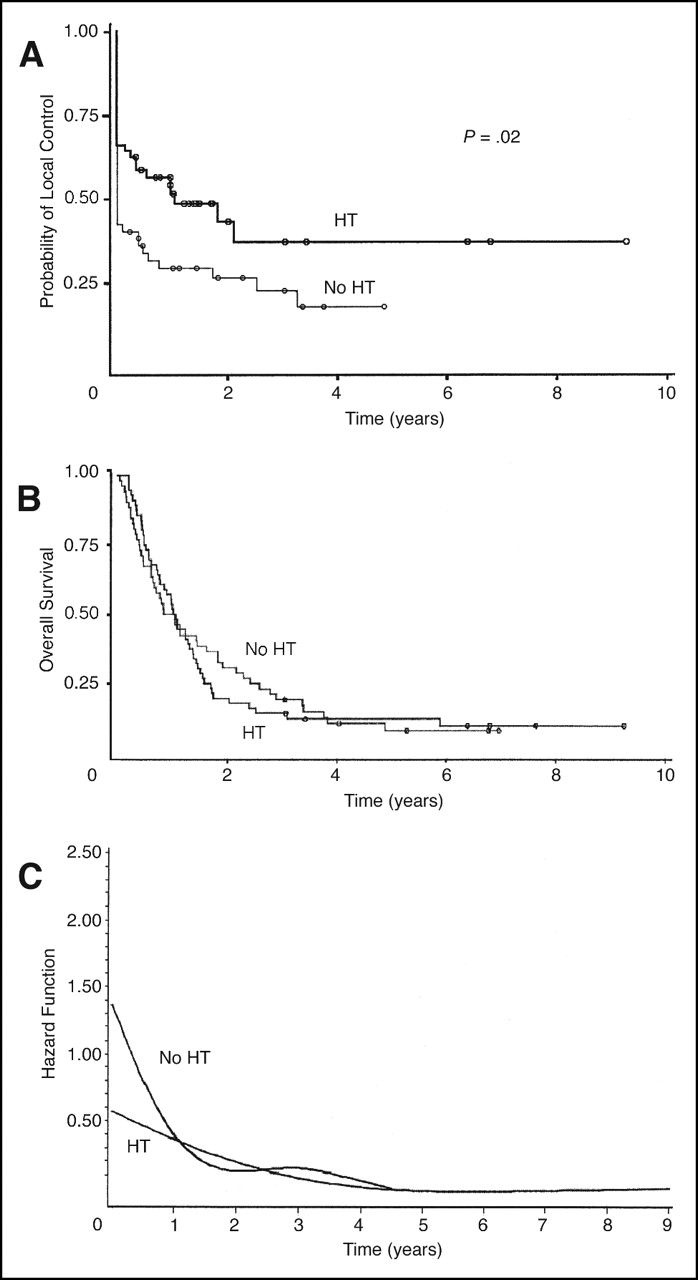
De titel oppervlakkige tumoren is beetje misleidend naar mijn mening want onder de patiënten zijn ook borstkankerpatienten, melanoompatienten enz. Wellicht dat daardoor de overall overleving op langere termijn weinig verschil liet zien. De onderzoekers merken ook op dat het effect van de hyperthermie naast de bestraling - radiotherapie het grootst was in het eerste half jaar. De response met CR - complete remissies en PR - gedeeltelijke remissies was overigens best nog wel groot: Verschil van CR + PR van 66.1% voor de hyperthermiegroep versus 42.3% zonder hyperthermie en bij patienten die al eerder bestraald waren was het verschil nog groter: 68.2% voor de hyperthermie plus bestraling versus 23.5% voor de groep die alleen bestraling en geen hyperthermie kreeg. Zie verderop de grafieken en de resultaten.

Resultaten 120 patiënten deden mee in deze studie. 109 (89%) zouden geschikt zijn voor een behandeling met hyperthermie. Deze werden gerandomiserd ingedeeld in wel en geen hyperthermie (2x per week hyperthermie). De complete response was 66.1% in de bestraling plus hyperthermiegroep en 42.3% in de bestralingsgroep zonder hyperthermie. Odds ratio voor complete response was 2.7 (95% CI, 1.2 tot 5.8; P = .02). Patienten die eerder waren bestraald profiteerden het meest van de hyperthermie d.m.v. een CR - complete response. : 23.5% in de bestralingsgroep zonder hyperthermie versus 68.2% in de bestraling plus hyperthermiegroep. er werd geen statistisch significante overall oveerleving gezien tussen beide groepen. (Red: zie mijn commentaar daarop hierboven en hieronder.)
Conclusie: Aanvullende hyperthermie naast radiotherpaie - bestraling met een dosis van meer dan 10 CEM 43°C T90 geeft een statistisch significant betere lokale controle bij kankerpatiënten met oppervlakkige tumoren. Ziee hieronder de grafieken.
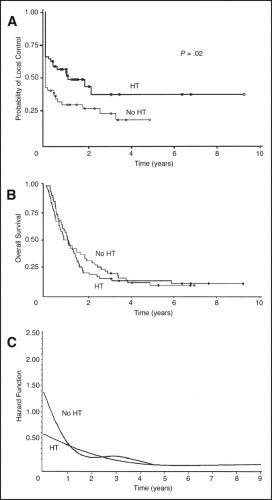
16 mei 2005: Bron: J Clin Oncol. 2005 May 1;23(13):3079-85.
Hyperthermie als aanvulling op bestraling van oppervlakkige tumoren geeft een significant beter direct resultaat (respons), maar volgens èèn zinnetje in het abstract geen significant verschil in uiteindelijke overleving. Helaas is alleen een abstract beschikbaar (we hebben aan mailtje gestuurd met vraag voor het volledige studieverslag, maar nooit gekregen) en weten we ook niet welk soort oppervlakkige tumoren behandeld zijn en hoe precies de cijfers liggen. Het maakt nogal verschil of een huidtumor van niet melanome afkomst wordt bestraald of dat een aan de oppervlakte gelegen borsttumor bestraald wordt. Bij de laatste wordt alleen lokaal een zichtbare tumor behandeld maar is duidelijk dat de oorsprong dieper in het lichaam zit. Effect op overleving mag dan ook niet worden verwacht of ook de dieper ligende tumoren zouden moeten worden behandeld met zelfde behandelingsprotocol. Hier het summiree abstract van deze gerandomiseerde studie. Randomized trial of hyperthermia and radiation for superficial tumors.
Jones EL, Oleson JR, Prosnitz LR, Samulski TV, Vujaskovic Z, Yu D, Sanders LL, Dewhirst MW.
Radiation Oncology, Duke University Medical Center, DUMC Box 3085, Durham, NC 27710, USA. Jones@radonc.duke.edu
PURPOSE: Randomized clinical trials have demonstrated hyperthermia (HT) enhances radiation response. These trials, however, generally lacked rigorous thermal dose prescription and administration. We report the final results of a prospective randomized trial of superficial tumors (
METHODS: This trial was designed to test whether a thermal dose of more than 10 CEM 43 degrees C T(90) results in improved complete response and duration of local control compared with a thermal dose of
RESULTS: One hundred twenty-two patients were enrolled; 109 (89%) were deemed heatable and were randomly assigned. The complete response rate was 66.1% in the HT arm and 42.3% in the no-HT arm. The odds ratio for complete response was 2.7 (95% CI, 1.2 to 5.8; P = .02). Previously irradiated patients had the greatest incremental gain in complete response: 23.5% in the no-HT arm versus 68.2% in the HT arm. No overall survival benefit was seen.
CONCLUSION: Adjuvant hyperthermia with a thermal dose more than 10 CEM 43 degrees C T(90) confers a significant local control benefit in patients with superficial tumors receiving radiation therapy.
PMID: 15860867 [PubMed - in process]
Referentielijst van hyperthermie bij oppervlakkige tumoren
REFERENCES
- ↵
Lepock JR: Cellular effects of hyperthermia: Relevance to the minimum dose for thermal damage. Int J Hyperthermia 19:252-266, 2003
- ↵
Mivechi NF, Dewey WC: DNA polymerase alpha and beta activities during the cell cycle and their role in heat radiosensitization in Chinese hamster ovary cells. Radiat Res 103:337-350, 1985
- ↵
Armour EP, McEachern D, Wang Z, et al: Sensitivity of human cells to mild hyperthermia. Cancer Res 53:2740-2744, 1993
- ↵
Koutcher JA, Barnett D, Kornblith AB, et al: Relationship of changes in pH and energy status to hypoxic cell fraction and hyperthermia sensitivity. Int J Radiat Oncol Biol Phys 18:1429-1435, 1990
- ↵
Engin K, Leeper D, Thistlethwaite A, et al: Tumor extracellular pH as a prognostic factor in thermoradiotherapy. Int J Radiat Oncol Biol Phys 29:125-132, 1994
- ↵
Song CW: Effect of local hyperthermia on blood flow and microenvironment: A review. Cancer Res 44:4721s-4730s, 1984
- ↵
Dewhirst MW, Viglianti BL, Lora-Michiels M, et al: Basic principles of thermal dosimetry and thermal thresholds for tissue damage from hyperthermia. Int J Hyperthermia 19:267-294, 2003
- ↵
Vernon CC, Hand JW, Field SB, et al: Radiotherapy with or without hyperthermia in the treatment of superficial localized breast cancer: Results from five randomized controlled trials—International Collaborative Hyperthermia Group. Int J Radiat Oncol Biol Phys 35:731-744, 1996
-
Overgaard J, Gonzalez Gonzalez D, Hulshof MC, et al: Randomised trial of hyperthermia as adjuvant to radiotherapy for recurrent or metastatic malignant melanoma: European Society for Hyperthermic Oncology. Lancet 345:540-543, 1995
-
Valdagni R, Amichetti M: Report of long-term follow-up in a randomized trial comparing radiation therapy and radiation therapy plus hyperthermia to metastatic lymph nodes in stage IV head and neck patients. Int J Radiat Oncol Biol Phys 28:163-169, 1994
-
Datta NR, Bose AK, Kapoor HK, et al: Head and neck cancers: Results of thermoradiotherapy versus radiotherapy. Int J Hyperthermia 6:479-486, 1990
- ↵
van der Zee J, Gonzalez Gonzalez D, van Rhoon GC, et al: Comparison of radiotherapy alone with radiotherapy plus hyperthermia in locally advanced pelvic tumours: A prospective, randomised, multicentre trial—Dutch Deep Hyperthermia Group. Lancet 355:1119-1125, 2000
-
Harima Y, Nagata K, Harima K, et al: A randomized clinical trial of radiation therapy versus thermoradiotherapy in stage IIIB cervical carcinoma. Int J Hyperthermia 17:97-105, 2001
-
Sharma S, Sandhu AP, Patel FD, et al: Side-effects of local hyperthermia: Results of a prospectively randomized clinical study. Int J Hyperthermia 6:279-285, 1990
- ↵
Sneed PK, Stauffer PR, McDermott MW, et al: Survival benefit of hyperthermia in a prospective randomized trial of brachytherapy boost +/- hyperthermia for glioblastoma multiforme. Int J Radiat Oncol Biol Phys 40:287-295, 1998
- ↵
Dewhirst MW, Griffin TW, Smith AR, et al: Intersociety Council on Radiation Oncology essay on the introduction of new medical treatments into practice. J Natl Cancer Inst 85:951-957, 1993
- ↵
Sapareto SA, Dewey WC: Thermal dose determination in cancer therapy. Int J Radiat Oncol Biol Phys 10:787-800, 1984
- ↵
Oleson JR, Samulski TV, Leopold KA, et al: Sensitivity of hyperthermia trial outcomes to temperature and time: Implications for thermal goals of treatment. Int J Radiat Oncol Biol Phys 25:289-297, 1993
- ↵
Hardenbergh PH, Bentel GC, Prosnitz LR, et al: Postmastectomy radiotherapy: Toxicities and techniques to reduce them. Semin Radiat Oncol 9:259-268, 1999
- ↵
Samulski TV, Fessenden P, Lee ER, et al: Spiral microstrip hyperthermia applicators: Technical design and clinical performance. Int J Radiat Oncol Biol Phys 18:233-242, 1990
- ↵
Dewhirst MW, Phillips TL, Samulski TV, et al: RTOG quality assurance guidelines for clinical trials using hyperthermia. Int J Radiat Oncol Biol Phys 18:1249-1259, 1990
- ↵
Engler MJ, Dewhirst MW, Winget JM, et al: Automated temperature scanning for hyperthermia treatment monitoring. Int J Radiat Oncol Biol Phys 13:1377-1382, 1987
- ↵
Hand JW, Machin D, Vernon CC, et al: Analysis of thermal parameters obtained during phase III trials of hyperthermia as an adjunct to radiotherapy in the treatment of breast carcinoma. Int J Hyperthermia 13:343-364, 1997
- ↵
Sherar M, Liu FF, Pintilie M, et al: Relationship between thermal dose and outcome in thermoradiotherapy treatments for superficial recurrences of breast cancer: Data from a phase III trial. Int J Radiat Oncol Biol Phys 39:371-380, 1997
- ↵
Caplan RJ, Pajak TF, Cox JD: Analysis of the probability and risk of cause-specific failure. Int J Radiat Oncol Biol Phys 29:1183-1186, 1994
- ↵
Kalbfleisch JD: The Statistical Analysis of Failure Time Data (ed 2). New York, NY, Wiley, 2002
- ↵
Perez CA, Pajak T, Emami B, et al: Randomized phase III study comparing irradiation and hyperthermia with irradiation alone in superficial measurable tumors: Final report by the Radiation Therapy Oncology Group. Am J Clin Oncol 14:133-141, 1991
- ↵
Perez CA, Gillespie B, Pajak T, et al: Quality assurance problems in clinical hyperthermia and their impact on therapeutic outcome: A report by the Radiation Therapy Oncology Group. Int J Radiat Oncol Biol Phys 16:551-558, 1989
- ↵
Kapp DS, Petersen IA, Cox RS, et al: Two or six hyperthermia treatments as an adjunct to radiation therapy yield similar tumor responses: Results of a randomized trial. Int J Radiat Oncol Biol Phys 19:1481-1495, 1990
- ↵
Engin K, Tupchong L, Moylan DJ, et al: Randomized trial of one versus two adjuvant hyperthermia treatments per week in patients with superficial tumours. Int J Hyperthermia 9:327-340, 1993
- ↵
Carter DL, MacFall JR, Clegg ST, et al: Magnetic resonance thermometry during hyperthermia for human high-grade sarcoma. Int J Radiat Oncol Biol Phys 40:815-822, 1998
Articles citing this article
hyperthermie, bestraling, radiotherapie, oppervlakkige tumoren, borstkanker, melanomen
Gerelateerde artikelen




Plaats een reactie ...
Reageer op "Oppervlakkige tumoren: hyperthermie als aanvulling op bestraling geeft significant betere respons bij oppervlakkige tumoren aldus gerandomiseerde studie."